
1. CYBERSECURITY AWARENESS
CYBERSECURITY AWARENESS
TECHNOLOGY SUPPORT SERVICES UNIT
CYBERSECURITY
The connected electronic information network has become an integral part of our daily lives. All types of organizations, such as medical, financial, and education institutions, use this network to operate effectively. They utilize the network by collecting, processing, storing, and sharing vast amounts of digital information.
As more digital information is gathered and shared, the protection of this information is becoming even more vital to our national security and economic stability.
Cybersecurity is the ongoing effort to protect these networked systems and all of the data from unauthorized use or harm. On a personal level, you need to safeguard your identity, your data, and your computing devices.
At the corporate level, it is everyone’s responsibility to protect the organization’s reputation, data, and customers. At the state level, national security, and the safety and well-being of the citizens are at stake.
YOUR ONLINE AND OFFLINE IDENTITY
As more time is spent online, your identity, both online and offline, can affect your life. Your offline identity is the person who your friends and family interact with on a daily basis at home, at school, or work. They know your personal information, such as your name, age, or where you live. Your online identity is who you are in cyberspace. Your online identity is how you present yourself to others online. This online identity should only reveal a limited amount of information about you.
YOUR DATA
Any information about you can be considered to be your data. This personal information can uniquely identify you as an individual. This data includes the pictures and messages that you exchange with your family and friends online. Other information, such as name, social security number, date and place of birth, or mother‘s maiden name, is known by you and used to identify you. Information such as medical, educational, financial, and employment information, can also be used to identify you online.
YOUR DATA
a. Medical Records
b. Education Records
c. Employment Records
d. Financial Records
YOUR COMPUTING DEVICE
Your computing devices do not just store your data. Now these devices have become the portal to your data and generate information about you.
THEY WANT YOUR MONEY
YOUR DATA
If you have anything of value, the criminals want it. Your online credentials are valuable. These credentials give the thieves access to your accounts.
A criminal could also take advantage of your relationships. They could access your online accounts and your reputation to trick you into wiring money to your friends or family. The criminal can send messages stating that your family or friends need you to wire them money so they can get home from abroad after losing their wallets.
THEY WANT YOUR IDENTITY
Besides stealing your money for a short-term monetary gain, the criminals want long-term profits by stealing your identity.
CIA TRIAD

CONFIDENTIALITY
Another term for confidentiality would be privacy.
INTEGRITY
Integrity is accuracy, consistency, and trustworthiness of the data during its entire life cycle.
AVAILABILITY
Maintaining equipment, performing hardware repairs, keeping operating systems and software up to date, and creating backups ensure the availability of the network and data to the authorized users.
CONSEQUENCES OF A SECURITY BREACH
-
Ruined Reputation
-
Vandalism
-
Theft
-
Revenue Lost
-
Damaged Intellectual Property
TYPES OF ATTACKERS
AMATEURS
These people are sometimes called Script Kiddies. They are usually attackers with little or no skill, often using existing tools or instructions found on the Internet to launch attacks. Some of them are just curious, while others are trying to demonstrate their skills and cause harm. They may be using basic tools, but the results can still be devastating.
HACKERS
This group of attackers break into computers or networks to gain access. Depending on the intent of the break-in, these attackers are classified as white, gray, or black hats.
WHITE HAT HACKERS
The white hat attackers break into networks or computer systems to discover weaknesses so that the security of these systems can be improved. These break-ins are done with prior permission and any results are reported back to the owner.
ORGANIZED HACKERS
These hackers include organizations of cyber criminals, hacktivists, terrorists, and state-sponsored hackers. Cyber criminals are usually groups of professional criminals focused on control, power, and wealth. The criminals are highly sophisticated and organized, and they may even provide cybercrime as a service to other criminals. Hacktivists make political statements to create awareness to issues that are important to them.
BLACK HAT HACKERS
Black hat attackers take advantage of any vulnerability for illegal personal, financial or political gain. These are unethical criminals who violate computer and network security.
GRAY HAT HACKERS
The gray hat attackers may find a vulnerability in a system. Gray hat hackers may report the vulnerability to the owners of the system if that action coincides with their agenda. Some gray hat hackers publish the facts about the vulnerability on the Internet so that other attackers can exploit it.
INTERNAL AND EXTERNAL THREATS

TYPES OF MALWARE
MALWARE
Short for Malicious Software, malware is any code that can be used to steal data, bypass access controls, or cause harm to, or compromise a system.
SPYWARE
This malware is design to track and spy on the user. Spyware often includes activity trackers, keystroke collection, and data capture. In an attempt to overcome security measures, spyware often modifies security settings. Spyware often bundles itself with legitimate software or with Trojan horses.
ADWARE
Advertising supported software is designed to automatically deliver advertisements. Adware is often installed with some versions of software. Some adware is designed to only deliver advertisements but it is also common for adware to come with spyware.
BOT
From the word robot, a bot is malware designed to automatically perform action, usually online. While most bots are harmless, one increasing use of malicious bots are botnets. Several computers are infected with bots which are programmed to quietly wait for commands provided by the attacker.
RANSOMWARE
This malware is designed to hold a computer system or the data it contains captive until a payment is made. Ransomware usually works by encrypting data in the computer with a key unknown to the user. Some other versions of ransomware can take advantage of specific system vulnerabilities to lock down the system. Ransomware is spread by a downloaded file or some software vulnerability.
VIRUS
A virus is malicious executable code that is attached to other executable files, often legitimate programs. Most viruses require end-user activation and can activate at a specific time or date. Viruses can be harmless and simply display a picture or they can be destructive, such as those that modify or delete data. Viruses can also be programmed to mutate to avoid detection. Most viruses are now spread by USB drives, optical disks, network shares, or email.
TROJAN HORSE
A Trojan horse is malware that carries out malicious operations under the guise of a desired operation. This malicious code exploits the privileges of the user that runs it. Often, Trojans are found in image files, audio files or games. A Trojan horse differs from a virus because it binds itself to non-executable files.
WORMS
Worms are malicious code that replicate themselves by independently exploiting vulnerabilities in networks. Worms usually slow down networks. Whereas a virus requires a host program to run, worms can run by themselves. Other than the initial infection, they no longer require user participation. After a host is infected, the worm is able to spread very quickly over the network. Worms share similar patterns. They all have an enabling vulnerability, a way to propagate themselves, and they all contain a payload.
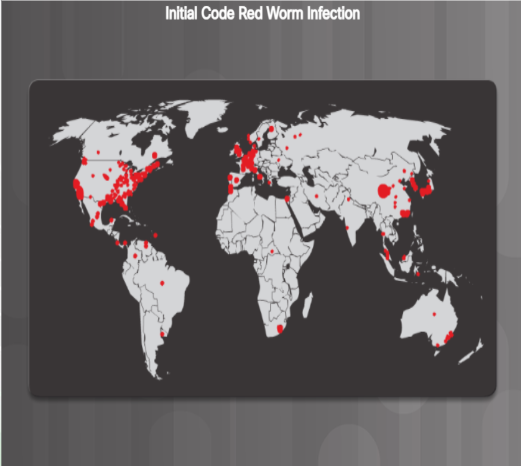
Worms are responsible for some of the most devastating attacks on the Internet. In 2001 the Code Red worm had infected 658 servers. Within 19 hours, the worm had infected over 300,000 servers
METHODS OF INFILTRATION
SOCIAL ENGINEERING
Social engineering is an access attack that attempts to manipulate individuals into performing actions or divulging confidential information. Social engineers often rely on people’s willingness to be helpful but also prey on people’s weaknesses. For example, an attacker could call an authorized employee with an urgent problem that requires immediate network access. The attacker could appeal to the employee’s vanity, invoke authority using name-dropping techniques, or appeal to the employee’s greed.
TYPES OF SOCIAL ENGINEERING
Pretexting - This is when an attacker calls an individual and lies to them in an attempt to gain access to privileged data. An example involves an attacker who pretends to need personal or financial data in order to confirm the identity of the recipient.
Tailgating - This is when an attacker quickly follows an authorized person into a secure location.
Something for Something (Quid pro quo) - This is when an attacker requests personal information from a party in exchange for something, like a free gift.
WI-FI PASSWORD CRACKING
Social engineering – The attacker manipulates a person who knows the password into providing it.
Brute-force attacks – The attacker tries several possible passwords in an attempt to guess the password.
Network sniffing – By listening and capturing packets sent on the network, an attacker may be able to discover the password if the password is being sent unencrypted (in plain text). If the password is encrypted, the attacker may still be able to reveal it by using a password cracking tool.
PHISHING
Phishing is when a malicious party sends a fraudulent email disguised as being from a legitimate, trusted source. The message intent is to trick the recipient into installing malware on their device, or into sharing personal or financial information. An example of phishing is an email forged to look like it was sent by a retail store asking the user to click a link to claim a prize. The link may go to a fake site asking for personal information, or it may install a virus.