DNSC POLICIES ON WORKING HOURS AND FLEXIBLE WORK ARRANGEMENTS
| Site: | Knowledge Network and Organizational Wisdom Stream |
| Course: | HRMO Policies |
| Book: | DNSC POLICIES ON WORKING HOURS AND FLEXIBLE WORK ARRANGEMENTS |
| Printed by: | Guest user |
| Date: | Monday, 28 September 2026, 12:56 PM |

To ensure efficient and effective public service delivery, the standard policies on working hours and flexible work arrangements in the government service shall be adhered to in accordance with the rules and regulations of the Civil Service Commission (CSC):
-
CSC MC No. 06 s. 2022: Policies on Flexible Work Arrangements in the Government
-
CSC and DBM Joint Circular No. 1 s.2015: Policies and Guidelines on Overtime Services and Overtime Pay for Government Employees
-
CSC MC No. 21, s.1991: Policy on Working Hours for Government Employees
-
CSC MC No. 25, s.2019: Revised Guidelines on Flexible Working Hours in the Government
-
CSC MC No. 19, s.2012: Observance of Flag Raising Ceremonies
-
CSC MC No. 17, s.2010: Policy on Half Day Absence
-
CSC MC No. 16, s.2010: Policy on Undertime
-
Omnibus Civil Service Rules and Regulations
-
Compensatory Overtime Credit (COC) refers to the accrued number of hours an employee earns due to services rendered beyond regular working hours and/or those rendered on Saturdays, Sundays, Holidays, or scheduled days off without the benefit of overtime pay.
-
Compensatory Time-Off (CTO) refers to the number of hours or days an employee is excused from reporting for work with full pay and benefits. It is a non-monetary benefit provided to an employee in lieu of overtime pay.
-
Work from Home (WFH) is a work arrangement in which government officials or employees work from home or at their residences.
-
Work from Satellite Office is a work arrangement in which government officials or employees report to their agency satellite office near their place.
-
Work from another Fixed Place is a work arrangement in which government officials and employees render service within the Philippines at a place other than their home or residence and satellite office that is conducive to productive work and efficient performance of official duties and responsibilities.
-
Skeleton Workforce refers to a work arrangement in which a minimum number of government officials or employees are required to man the office and render service when full staffing is not possible.
-
Work Shifting refers to a work arrangement applicable to offices/agencies mandated by law to operate 24-hour continuous service on a daily basis or to agencies required to observe workplace health and safety protocols. This also applies to occupational groups that provide security and safety to agency personnel and/or property.
-
Flexitime refers to a work arrangement in which the agency can adopt a flexible work schedule for its government officials and employees from 7:00 AM to 7:00 PM daily, provided that the required forty (40) hours of workweek are complied with.
-
Combination of Flexible Work Arrangements refers to a unique work arrangement that allows the agency to adopt a mix of any flexible work arrangements, tailoring them to the agency's specific mandate/functions for optimal efficiency and productivity.
POLICIES ON WORKING HOURS
To ensure efficient and effective public service delivery, Davao del Norte State College regulated its working hour arrangements under CSC Memorandum Circular No. 21, s. 1991: Policy on Government Working Hours, CSC Memorandum Circular No. 25, s.2019: Revised Guidelines on Flexible Working Hours in the Government and CSC Memorandum Circular No. 06, s.2022: Policies on Flexible Work Arrangements in the Government.
a. Regular Working Hours
a1. Non-Teaching Staff
Official Time shall be from 8:00 AM to 12:00 NN and from 1:00 PM to 5:00 PM, from Monday to Friday.
Non-teaching staff may observe flexible work hours subject to the following conditions: they may start anytime between 7:00 AM and 10:00 AM and end between 4:00 PM and 7:00 PM, except on days when all non-teaching staff should be in the office at 8:00 AM for the flag-raising ceremonies, provided that they render a total of 40 hours of work per week, exclusive of lunch break.
The choice of work schedule shall be established individually by and between the staff and the immediate supervisor and must be fixed for six months, from January to June and July to December.
a.2 Faculty with no Designation
The standard official time shall be from 8:00 AM to 12:00 NN and from 1:00 PM to 5:00 PM, from Monday to Friday. However, due to variations of work and teaching loads and their corresponding time schedules, flexible working hours may be allowed to faculty members, taking into consideration that it shall cover the class schedule for the assigned teaching loads and other designated workloads, provided further that they render a total of 40 hours of work per week, exclusive of lunch break.
Faculty with class schedules at 8:00 AM on Mondays and 5:00 PM on Fridays shall be exempted from the flag-raising and lowering ceremonies.
The choice of work schedule shall be established individually by and between the faculty and the Dean and must be fixed for a semester except for faculty with class schedules in the special program.
a.3 Faculty with Administrative Designation
The standard official time shall be from 8:00 AM to 12:00 NN and from 1:00 PM to 5:00 PM, Monday through Friday. However, employees may observe flexible work hours subject to the following conditions: they may start anytime between 7:00 AM and 9:00 AM and end between 4:00 PM and 6:00 PM except on days when all employees should be in the office at 8:00 AM for the flag-raising ceremonies, provided that they render a total of 40 hours of work per week, exclusive of lunch break.
Official Time for Faculty with designation assigned at the Graduate School may start anytime between 7:30 AM and 8:30 AM and end between 4:30 PM and 5:30 PM. Since Graduate School classes are on Saturday, faculty will have one (1) day off during weekdays except Monday, when all employees should attend the flag-raising ceremonies. If the faculty are requested to report on a day off during weekdays, they will be entitled to compensatory overtime credits subject to the approval of the President before the period they render the services.
The choice of work schedule shall be established individually by and between the faculty and the Dean and must be fixed for a semester except for faculty with class schedules in the special program.
b. Shifting Work Schedule for Non-Teaching Staff
A shifting work schedule for Non-Teaching Staff may be allowed provided that at least eight (8) hours of work a day is rendered, exclusive of meal breaks, and that such shift will not affect the office core operating hours of 8:00 AM to 5:00 PM for the duration of the work week.
c. Use of Locator Slip thru Human Resource Information System (HRIS)
A locator slip shall be issued to employees seeking authority and clearance to transact official or personal business outside DNSC during office hours. The immediate head shall approve the locator slip.
c.1 Official business includes transactions involving official duties outside DNSC and other assignments authorized by the immediate supervisor.
c.2 All employees (permanent, casual, temporary, contract of service, job order) may be issued a locator slip for personal reasons on official time not to exceed two (2) hours a day for a maximum of two (2) times a month which may be due to the following:
c.2.1 Medical consultation and treatment in the family
c.2.2 Over-the-counter Bank transactions
c.2.3 Accidents or death in the family
c.2.4 Transactions with government and private offices
c.2.5 Parental obligations such as attendance in school programs and PTA meetings
c.2.6 The Immediate Head may deem other similar or analogous circumstances justified.
c.3 Employees can only use the Locator slip within Panabo City.
c.4 Employees should not print the approved Locator slips from the Human Resource Information System. Upon approval of the request, the system will generate a QR Code, which can be screen-captured, printed, or, in whatever convenient manner, presented to the guard-on-duty upon leaving and returning to the campus. Failure to present the QR Code to the guard on duty shall mean that the hours that the employee was out of the office shall be considered unauthorized and deducted from the accumulated leave credits of the concerned employee, if any, or from the payroll in case there are no leave credits available. It may also be grounds for administrative sanction for violating reasonable office rules and regulations.
c.5 Immediate Heads shall monitor the use of Locator slips in their respective unit.
d. Breaktime
d.1 Regular lunch breaks shall be observed from 12:00 NN to 1:00 PM. However, to ensure that the “NO NOON BREAK” policy is being implemented, a shifting of schedule during lunch shall be observed, as follows:
11:00 AM – 12:00 NN
12:00 NN – 1:00 PM
1:00 PM – 2:00 PM
d.2 Two (2) fifteen-minute breaks shall be observed between 9:30 AM and 10:30 AM and 2:30 PM TO 3:30 PM.
d.3 One (1) to Two (2) hours of mental health break shall be observed from 3:00 PM to 5:00 PM every Wednesday as per approved Employees Mental Health and Wellness Program.
e. Tardiness and Undertime
e1. Tardiness
In accordance to CSC Memorandum Circular No. 17, s.2010 Policy on Half Day Absence, not arriving on time or time-in beyond the start of the official work schedule in the morning and afternoon shall be considered tardiness. Employees may incur tardiness twice in one working day, one in the morning and another in the afternoon. Any official or employee absent in the morning is considered tardy. When an employee is not feeling well or is sick and needs to be absent for half a day, the employee may file sick leave for half a day.
e2. Undertime
If the employee left work earlier than its standard working hour or absent in the afternoon, these actions shall be incurred undertime under CSC Memorandum Circular No. 17, s.2010 Policy on Half Day Absence. Off-setting of tardiness or undertime shall not be allowed.
e3. Disciplinary action pursuant to Rule 10, Section 50, (F) of the 2017 Rules on Administrative Cases in the Civil Service (RACCS) shall be taken against an official or employee who:
e.3.1 incurs tardiness, regardless of the number of minutes or hours per day, 10 times a month for at least two (2) consecutive months during the year or at least two (2) months in a semester (Section 8, Rule XVII, Omnibus Civil Service Rules and Regulations); and
e.3.2 incurs undertime, regardless of the number of minutes or hours, 10 times a month for at least two (2) months in a semester or at least two (2) consecutive months during the year (CSC Memorandum Circular No. 16, s.2010).
f. Daily Time Record (DTR)
f.1 All employees shall use the in-house attendance system to record attendance by tapping their Radio Frequency Identification (RFID) Card at nearby tapping stations.
f.2 The printed DTR shall not be altered or erased. If the printout contains an inaccurate time, it should be referred to the HRMO Staff in charge of the attendance system.
f.3 Employees shall register their core time in the Human Resource Information System (HiS). Employees also shall register their time-in and time-out in case of approved overtime services.
f.4 Employees are strictly prohibited from letting their colleagues tap using their RFID.
f.5 The immediate head of office shall ensure that employees are back at their workstations immediately after the prescribed lunch break.
f.6 Manual entries in blank fields of the printed computer-generated DTR may be allowed in case of a Work-From-Home scheme, error in the machine/system, or mistake in the RFID provided that the concerned employee duly signs each manual entry.
f.7 In case of blank fields in the computer-generated DTR due to official travel or meetings and digital disruptions, the immediate heads shall require the concerned employee to attach the approved travel order, certificate of appearance, and other evidence of meetings conducted and proof of disruptions.
f.8 If the computer-generated DTR has a blank field because the employee left the RFID at home, the concerned employee shall fill out an excuse slip for not having an RFID card at the guard house; this excuse slip shall be attached to the DTR.
f.9 In case personnel are negligent in tapping their RFID, the immediate head shall require the employee to provide explanation on the matter before approving their DTR.
g. Out-of-Town Assignment
All employees shall apply for a Travel Order thru Human Resource Information System (HiS) prior to the date of the activity, subject to the approval of immediate supervisor and College President.
h. Renewal of Professional Identification Cards
Pursuant to Civil Service Commission Memorandum Circular No. 18, S.2018 Attendance in Continuing Professional Development Courses and Renewal of Professional Identifications Cards (PIDs), all government professionals are granted one (1) day on official time or every three (3) years for the renewal of their Professional Identification Cards.
RENDITION OF OVERTIME SERVICES
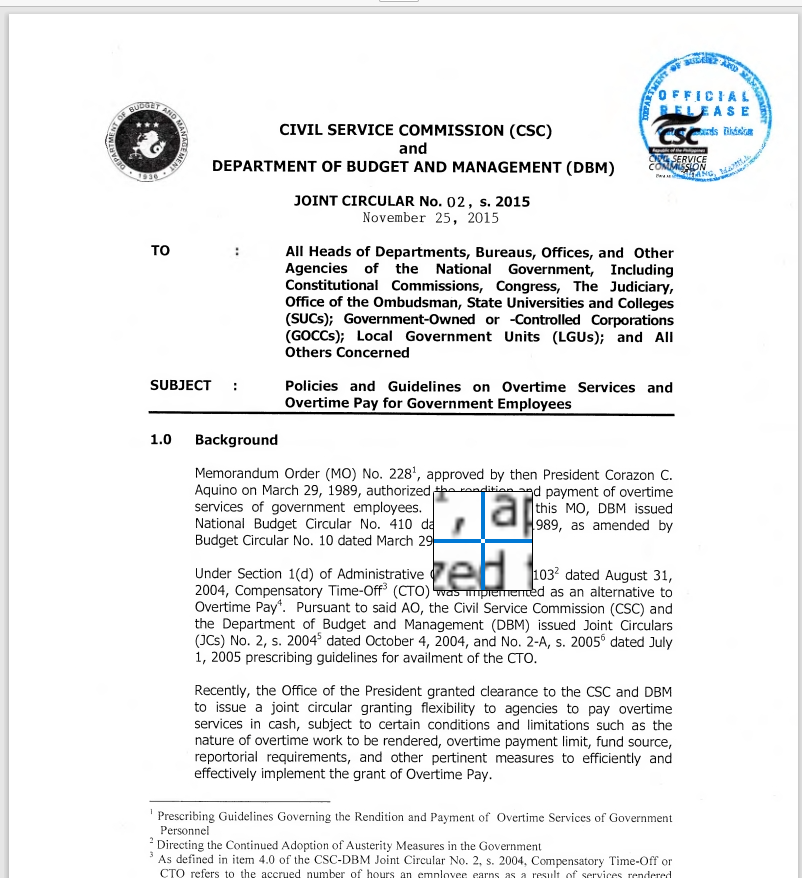
Pursuant to CSC-DBM Joint Circular No. 1, dated November 25, 2015, the DNSC President is granted the flexibility to authorize the rendition of overtime services and the payment thereof, either through Compensatory Time Off (CTO) for Plantilla Personnel and Overtime Pay for Job Order and Contract of Service Personnel.
a. All employees shall be entitled to overtime services, provided they have an approved overtime workload program, and shall be authorized only when necessary.
b. As a general rule, plantilla personnel shall be compensated for overtime services through Compensatory Time Off (CTO) in accordance with the guidelines under the CSC-DBM Joint Circulars No. 2, s.2004 and No. 2-A, s. 2005. For Job Order and Contract of Service employees, remuneration for overtime services shall be paid in cash through overtime pay
c. The rendition of overtime services may be authorized beyond 8 work hours of regular workdays or 40 hours a week, and those rendered on rest days or scheduled days off, holidays, and special non-working days, exclusive of one-hour rest for breakfast, lunch, and dinner. The priority activities that may warrant the rendition of necessary overtime services may include the following:
c.1. Seasonal work, such as but not limited to:
c.1.1 Quality Assurance activities (ISO, AACCUP, COPC, PQA, and QA activities);
c.1.2 completion of infrastructure and other projects with set deadlines when, due to unforeseen events, the deadline cannot meet without resorting to overtime work;
c.1.3 preparation of budgets and annual reports to meet scheduled deadlines;
c.1.4 preparation of financial and accountability reports with set deadlines and required by oversight agencies like Congress of the Philippines, Office of the President, Commission on Audit (COA), Department of Budget and Management (DBM), National Economic and Development Authority (NEDA) and Commission on Higher Education (CHED);
c.1.5 Board of Trustees (BOT) Activities: From Board Executive Committee (BEC) meeting and BOT meeting;
c.1.6 preparation for Institutional Activities (Charter Day, Intramurals, Recognition and Graduation Rites, Philippine Civil Service Anniversary Celebration, Research Congress and other similar activities; and
c.1.7 such other activities as are needed to meet performance targets or deliver service to the public as may be determined by the agency head.
d. Actual rendition of overtime services can only be availed one (1) week or two (2) before the scheduled/deadline of activities;
e. The SUC President is authorized to approve the rendition of overtime services and grants the following flexibilities:
e.1 determination of the priority activities that may warrant the rendition of overtime services and the timing and duration thereof;
e.2 determination of employees who may be authorized to render overtime services; and
e.3 determination of the number of hours of overtime services.
Limitations on Overtime Services and Overtime Pay
a. Only employees who arrive on or before the start of the workday shall be allowed to render overtime work with pay, provided that at least two hours of overtime services are rendered.
b. Time-in for overtime services during regular workdays shall be within 30 minutes after registering time-out (i.e., after 5:00 PM but not later than 5:30 PM).
c. Employees who incur absences, tardiness, and undertime for at least three (3) times a week shall not be authorized to render OT services on their rest day. This is to ensure that employees are not rendering OT services to finish their backlog due to their absences, tardiness, or overtime on regular days.
d. One-hour breaks shall be observed for breakfast, lunch, and dinner, and one-hour breaks for rest every three hours of continuous overnight overtime service.
e. Overnight overtime service shall be rendered only when necessary. No employee shall be allowed to render overnight service for more than two (2) consecutive nights, for health reasons and to ensure employee productivity
f. Employee shall not use the overtime service period to offset undertime.
g. Only a minimum of four (4) hours and a maximum of twelve (12) hours of overtime services on a rest day or scheduled day off, holiday, or special non-working day shall be compensated through CTO for plantilla personnel and overtime pay for JO and COS.
h. The total overtime pay of a Job Order and COS employee in a year shall not exceed 50% of the total basic salary of the Employee for the year.
COMPUTATION OF OVERTIME SERVICES
a. compensation for overtime services shall cover those rendered beyond eight (8) hours of a regular day and those rendered on rest days and non-working holidays.
b. Job Order and COS employees rendering overtime services shall be entitled to overtime pay by the hour, which shall be based on the employee’s actual hourly rate, computed as follows:
Actual Hourly Rate = Actual Salary per Month / 22 / 8
REQUIREMENTS UPON CLAIMING OF OVERTIME PAY AND COMPENSATORY TIME OFF
a. Plantilla personnel shall fill up the CTO form from the Human Resource Management Office, attaching the following documents:
a.1 Approved Daily Time Record (DTR) highlights the overtime services
a.2 Accomplishment Report duly signed/approved by the Immediate Head
a.3 Approved Request for Overtime Services
POLICIES ON FLEXIBLE WORK ARRANGEMENTS
DNSC is authorized to develop its policies and guidelines in adopting or implementing flexible work arrangements to institutionalize relevant and appropriate work arrangements.
General Requirements for Flexible Work Arrangements
a. The DNSC's implementation of work arrangements shall not prejudice the employees' participation in or involvement in the College's official activities.
b. The College shall ensure that all Stakeholders are assured of continuous service delivery from 8:00 AM to 5:00 PM, including lunch break, throughout the workweek.
c. The Immediate Head shall guide their subordinates in performing their assigned task/s according to their performance standards and timeliness while on flexible work arrangements.
d. The Immediate Heads shall adopt a monitoring mechanism, such as submitting weekly accomplishment reports, in accordance with the performance standards they agreed upon.
e. The College may adopt videoconferencing/teleconferencing when conducting meetings/assemblies and other official activities, whenever applicable.
PARAMETERS IN THE IMPLEMENTATION OF FLEXIBLE WORK ARRANGEMENT/S
1. Flexiplace
This refers to an output-oriented work arrangement that authorizes employees to render services at a location away from their office, either in the employee's home/residence, satellite campuses, or another fixed place temporarily duly approved by the President.
Flexiplace work arrangement has three (3) types that the DNSC adopts:
1.1 Work from home (WFH)
This is a work arrangement where DNSC employees can work at home or in their residences.
WFH may be adopted at any time, subject to mutually agreed arrangements between the immediate head and the employee duly recommended by the Director and Vice President and approved by the President. This will apply to employees whose assigned task/s can be accomplished outside the office.
WFH may likewise be extended to employees whose task/s cannot be accomplished at the office, satellite office, or another fixed place under the following situations:
a. During the emergence of a national or local outbreak of a severe infectious disease and/or the occurrence of natural or man-made calamities.
b. If an employee is, upon the advice of a physician, in isolation due to surgery or medical treatment, a medical certificate from the physician is required stating that the concerned employee can work from home. If the employee has a severe sickness, the employee can file sick leave for plantilla or be absent from work for a job order or contract of service status.
c. The Immediate Head shall determine and assign alternative task/s subject to the performance standards and timelines for completion. When the Immediate Head has not been assigned any other task/s, the concerned employee who could not produce outputs shall be considered on excused absence.
d. Task/s assigned to employees should be performed to the full extent possible in terms of work hours and workdays per workweek.
e. Unit Heads shall be responsible for monitoring the employee output scheme.
f. Employees under the WFH arrangement are not entitled to Compensatory Overtime Credit/Overtime Pay.
g. A duly approved accomplishment report on the WFH schedule shall be attached to the DTR.
1.2 Work from Satellite Office
This is a work arrangement in which DNSC employees report to work at the satellite campus near their residence instead of at their office.
a. Work from the satellite campus shall apply to employees whose task/s can be accomplished outside the employee’s main office and ensure that equipment/facilities are available in the nearest satellite campus.
b. For this purpose, the concerned employee shall request approval from the President, recommended by the Immediate Head and Vice President, so that the workload may be properly coordinated.
c. Work at the satellite office may be allowed when the employee cannot work due to typhoons/floods and other natural or man-made calamities upon approval of the President, except when the work arrangement is limited to WFH as declared by the President.
d. Employees who are stranded due to quarantine protocols, transportation inaccessibility, or inaccessible roads may also be allowed to work at satellite campuses.
e. Employees allowed to report for work at the satellite campuses shall comply with the prescribed working hours of forty (40) hours per workweek.
f. Unit Heads shall be responsible for monitoring the output of employees who report to work at the satellite campus.
1.3 Work from Another Fixed Place
This is a work arrangement where DNSC employees render service within the Philippines at a place other than their home or residence and satellite campus that is conducive to productive work and efficient performance of official duties and responsibilities.
a. Work from another fixed place shall apply to DNSC employees whose task/s can be accomplished outside the office at a place conducive to productive and efficient performance of official duties and responsibilities other than their home, residence, or satellite office.
b. For this purpose, the concerned employee shall request approval from the President, recommended by the Immediate Head of Office and Vice President, so that task/s may be properly assigned.
c. Employees whose task/s cannot be accomplished outside the office and are stranded at a place away from their home or satellite office due to quarantine protocols, unavailability of transportation, or inaccessible roads may be allowed to work from another fixed place arrangement provided that the College or Unit has assigned alternative task/s subject to the performance standards and timeliness.
d. Task/s assigned to employees should be fully performed possible regarding work hours and workdays per workweek.
e. The President shall take full responsibility for granting work from another fixed place and verifying the employee's entitlement to be given thereof. Said verification shall include validating the employees' location, confirming that their location is covered in the declaration of a state of calamity by the proper government agency, and obtaining such other evidence as may be necessary.
f. Employees under work from another fixed place arrangement are not entitled to Compensatory Overtime Credit/Overtime Pay.
g. Unit Heads shall be responsible for monitoring the output of employees who report to work from another fixed place.
h. The adoption of the flexiplace work arrangement may be allowed under any of the following conditions:
h.1 Regular— under this work arrangement, the employee may request to work at an alternative worksite on a regular and recurring basis. Said employee may be allowed to work off-site for a period agreed upon with the Immediate Head, recommended by the Vice President, and duly approved by the SUC President.
h.2 Situational – this work arrangement is appropriate for ad-hoc task/s or assignments that require/s a short period or project-based, e.g., project proposal preparation, reports preparation, research, case adjudication, and other analogous circumstances.
h.3 Medical – this work arrangement may be allowed for employees who are recuperating from a medical condition, e.g., Osteogenesis Imperfecta, cancer, diabetes mellitus, chronic kidney disease, and other analogous diseases, which does not affect the employees' ability to perform regular work assignment at an alternative worksite as certified by the attending physician. The duration of the flexiwork arrangement shall be based on the attending physician's recommendation. Request for flexiplace due to medical conditions shall be supported by the medical records of the employee concerned.
2. Skeleton Workforce
This refers to a work arrangement in which a minimum number of DNSC employees are required to man the office and render service when full staffing is not possible.
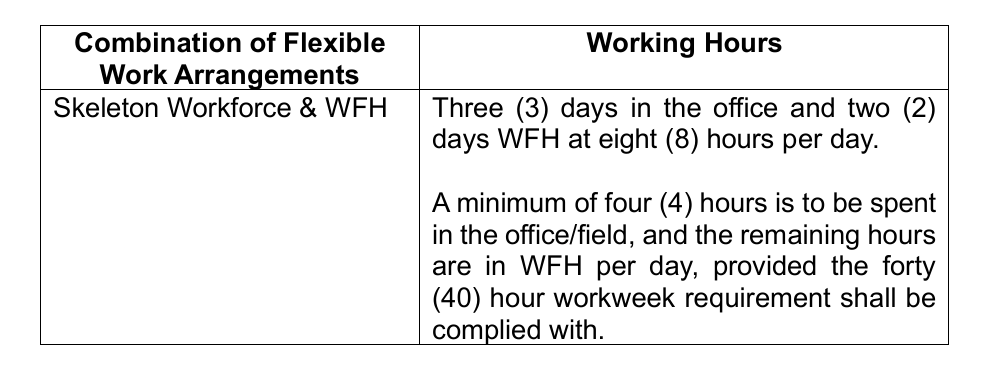
a. Employees assigned as skeleton workforce shall comply with the regular working hours of at least eight hours a day for five days a week or forty (40) hours a week, exclusive of time for lunch. However, if this work arrangement is adopted in combination with other flexible work arrangements, the required working hours shall be complied with.
b. The total number of employees making up the skeleton workforce shall be determined by the SUC President based on the services it provides and subject to existing guidelines, such as health protocols issued by the proper authorities.
c. This work arrangement shall be adopted only when necessary, through a memorandum from the SUC President.
d. The schedule for reporting to the office is fixed. Employees who do not report to the office on site on their assigned working days shall be considered absent, either as authorized or unauthorized vacation leave, unless a medical certificate is presented to avail of sick leave of absence—no swapping of schedule.
3. Work Shifting
This refers to a work arrangement applicable to units or offices mandated by law to operate 24-hour continuous service delivery on a daily basis. This arrangement applies to units/offices that provide security and safety to DNSC employees and to DNSC property (Security Services Unit and the DNSC Marine Reserve Park [MRP]).
4. Flexitime
This refers to a work arrangement where the agency can adopt a flexible fixed time for employees from 7:00 AM to 7:00 PM daily, provided that the required forty (40) hours workweek is complied with.
a. DNSC offers flexible time to employees who work at least forty (40) hours a week for five (5) days, excluding lunchtime.
b. The working hours shall start not earlier than 7:00 AM and end no later than 7:00PM for non-teaching staff. Faculty core time will depend upon their approved class schedules. Under this work arrangement, employees may choose their fixed time to report for work at the Human Resource Information System (HiS) (time-in) in the morning and time to leave the office (time-out) daily for the duration of six (6) months, January to June and July to December for Non-Teaching Staff. 1st and 2nd semesters for faculty are subject to the approval of the immediate head.
c. In the exigency of the service, working days may also be altered to include Saturdays and Sundays, if employees who work on such days may choose a day off during weekdays except Mondays (Flag Raising Ceremonies), provided further that the Saturday and Sunday are regular workdays and not cases of overtime.
5. Combination of Flexible Work Arrangements
This refers to a work arrangement whereby the college adopts a combination of any of the above-mentioned flexible work arrangements that are appropriate or applicable to the mandate/functions of the college as well as the location of their workplace:
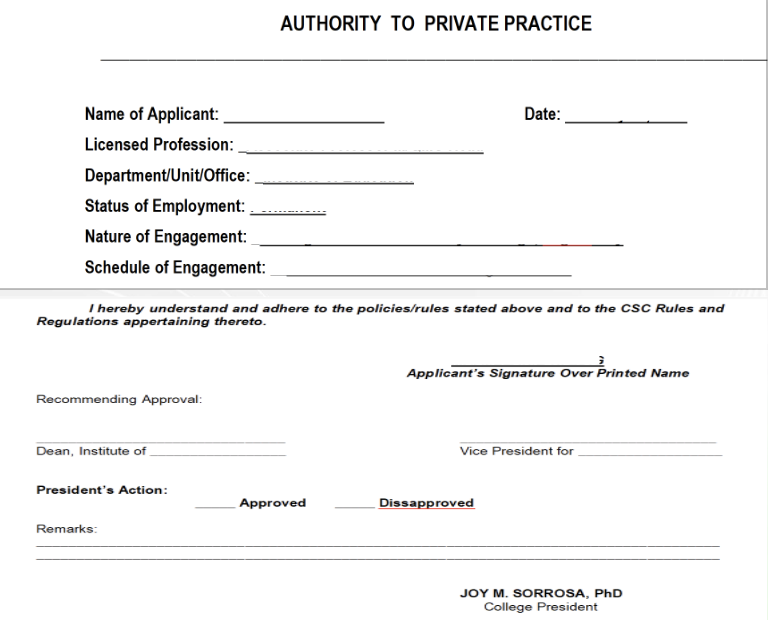
AUTHORITY TO PRIVATE PRACTICE
It is stated under Section 18, Rule XIII of the Revised Omnibus Rules on Appointments and Other Personnel Actions that:
“Unless otherwise provided by law, no officer or employee shall engage directly or indirectly in any private business or profession without a written permission from the head of agency. If an employee is granted permission to engage in outside activities, the time devoted outside of office hours should be fixed by the head of the agency so that it will not impair in any way the efficiency of the officer or employee nor pose a conflict or tend to conflict with the official functions.”
DNSC POLICY FOR PRIVATE PRACTICE
-
Official functions/duties must be of outmost priority over that of private practice and must not be hampered/impaired due to private practice.
-
Private of Practice of Profession should be done outside school premises.
-
Private practice must only be done beyond office hours.
-
School properties should not be used in private practice.
-
Any form of activity campaign/promotion related to private practice is strongly prohibited inside the school premises.
-
School properties such as office software, office supplies, equipment and the like should not be used in private practice.
-
Facilities for rent are subject to the approval of the rental agreement.